
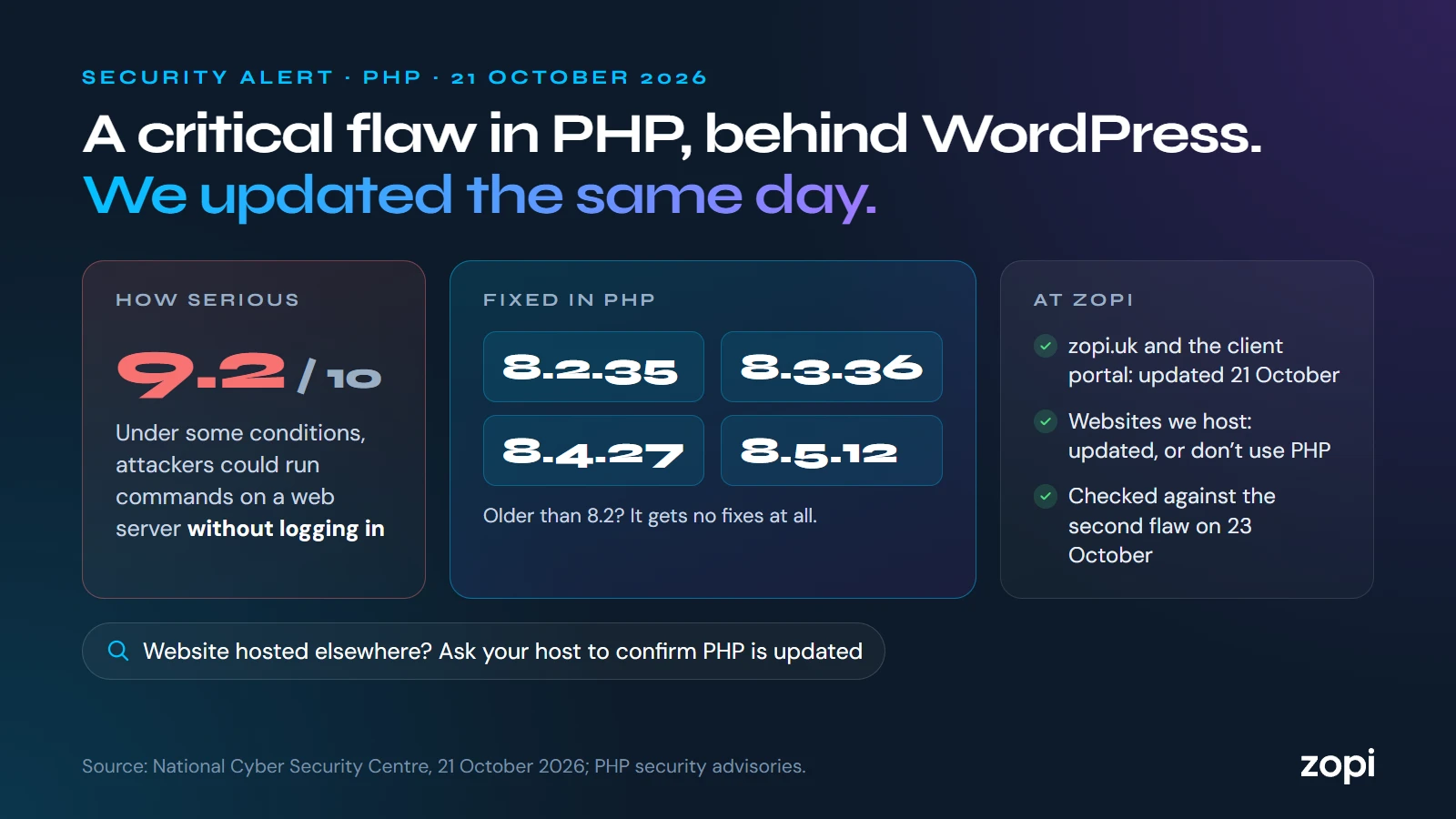
On 21 October the National Cyber Security Centre (NCSC) warned about a critical security flaw in PHP, the programming language that runs WordPress and millions of other websites. Under some conditions it lets an attacker run their own commands on a web server without logging in. Fixed versions came out the same day, and security firms report that attackers are already trying to use it.
What we've done
Our website, the Zopi client portal and the servers behind them were updated on 21 October, the day the warning came out. Every website we host either runs a fixed version of PHP or doesn't use PHP at all. You don't need to do anything for a site that's with us.
Is your website at risk?
If your website is hosted somewhere else, it's worth a quick check. Most business websites run on PHP, including every WordPress site.
- Ask your host whether PHP on your site has been updated for the October flaws, known as CVE-2026-109618 and CVE-2026-109619.
- The fixed versions are PHP 8.2.35, 8.3.36, 8.4.27 and 8.5.12, or newer. Some hosts use a version from Ubuntu or Debian, which can show an older number with the fix included, so ask them to confirm rather than going by the number alone.
- Versions older than 8.2 no longer get any fixes from PHP. A site on one of those needs moving to a current version.
- Keep WordPress up to date too. Plugins and themes are still the most common way into a WordPress site.
A second, smaller warning
Two days later, PHP warned about another flaw that doesn't have a fix yet. It only affects servers with an unusual session setting, and PHP has published a setting change that blocks it. We've checked: our servers don't use that setup.
How Zopi can help
If you're not sure who looks after your website, or it hasn't been updated in a while, we can check it for you. We design and host websites and keep them up to date, and our weekly checks of clients' domains already flag an out-of-date WordPress. Call us on 0204 502 1288 for a free, no-obligation chat.
Sources
- Critical security issue affecting PHP, National Cyber Security Centre, 21 October 2026
- PHP security advisory GHSA-w8hw-w9fx-j79w, PHP, 21 October 2026
- PHP warns of another unpatched RCE risk two days after emergency patches, The Hacker News, October 2026