
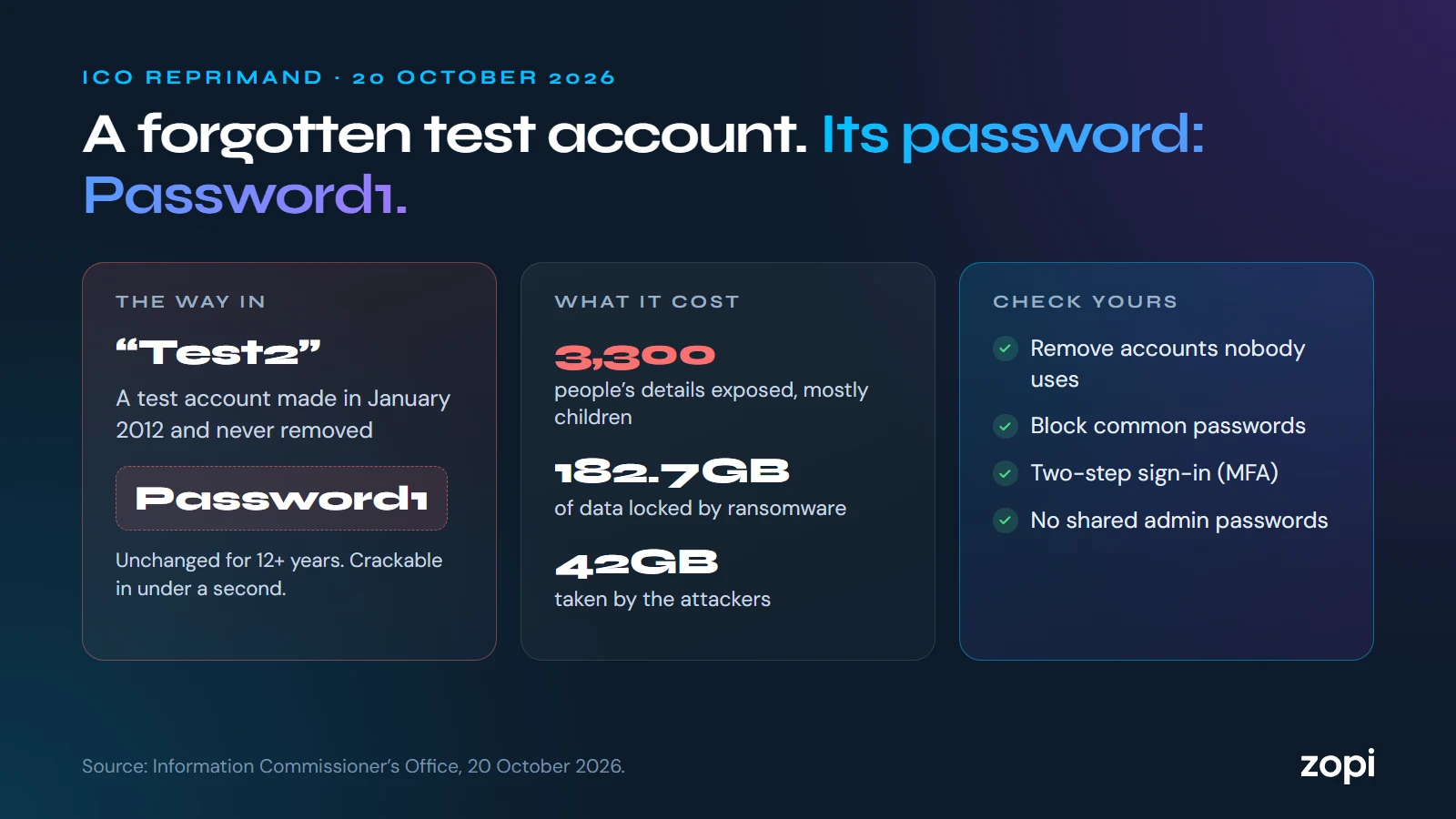
On 20 October the ICO, the UK's data protection regulator, reprimanded two Welsh organisations after a ransomware attack exposed the personal details of 3,300 people, most of them children. The attackers got in through a test account called "Test2". It had been set up in January 2012, nobody had removed it, and it still had its original password: Password1.
What happened
The two organisations were Data Cymru, which works with councils across Wales, and Ogi Networks, the IT company that looked after part of its network. Ogi created the test account; Data Cymru ran the network. Neither had a routine for finding and removing accounts that were no longer needed, so for more than 12 years the account sat there with a password that a password checker says could be cracked in under a second.
On 1 November 2024 attackers used it to get in. They locked 182.7GB of data with ransomware and took 42GB, including information from two projects supporting children and families. The ICO also found that administrator passwords on three of the systems hadn't changed in over 12 years, and that the two organisations had no proper contract saying who was responsible for what.
Why it matters for a small business
Almost every business has accounts like this: a login for someone who left years ago, a "test" or "scanner" account, a shared admin password everyone knows. They're easy to forget because nobody uses them, and that's exactly why attackers like them: no one notices when they're used.
Six things worth checking
These follow the ICO's own advice from the case:
- Remove accounts nobody needs. Former staff, old test accounts, and accounts made for a supplier who has finished. Check Microsoft 365, your computers and any server.
- Block weak passwords. Microsoft 365 and Windows can stop people choosing common passwords like Password1.
- Turn on two-step sign-in (MFA) for email and for anything you can reach from outside the office.
- Check every account, not just the ones you know about, including admin accounts and groups.
- Don't share admin passwords. Each person who needs admin access should have their own login.
- Be clear with your IT provider about who looks after what, and get it in writing.
How Zopi can help
We look after small businesses' cyber security day to day, including Microsoft 365 accounts, two-step sign-in and password rules. We can go through your accounts with you and give you a plain-English list of what to tidy up. Call us on 0204 502 1288 for a free, no-obligation chat.
Sources
- 'Password1' is not an appropriate password: two Welsh organisations reprimanded after cyber-attack exposed children's information, Information Commissioner's Office, 20 October 2026