
A new report, published on 20 October by De Montfort University (DMU) with the Research Institute for Sociotechnical Cyber Security (RISCS), warns that small businesses risk being left behind by the UK's cyber security plans. The government's own figures show why: nearly half of small businesses had a breach or attack last year, and fewer of them are doing the basics than a year before.
The "missing middle"
The report, *Beyond Policy to Place*, was written by Dr Ismini Vasileiou of DMU and the East Midlands Cyber Security Cluster. It describes a "missing middle" between national cyber security policy and what actually happens in businesses. In a small firm, security often falls to the managing director, the finance lead or a general IT provider, usually alongside everything else they do.
Its recommendations are practical: plain-English guidance, examples for each sector, simple tools and trusted routes to professional help, delivered through the regional groups, universities and business networks firms already know. As Dr Vasileiou puts it, "Cyber resilience is an essential business capability."
Fewer small businesses are doing the basics
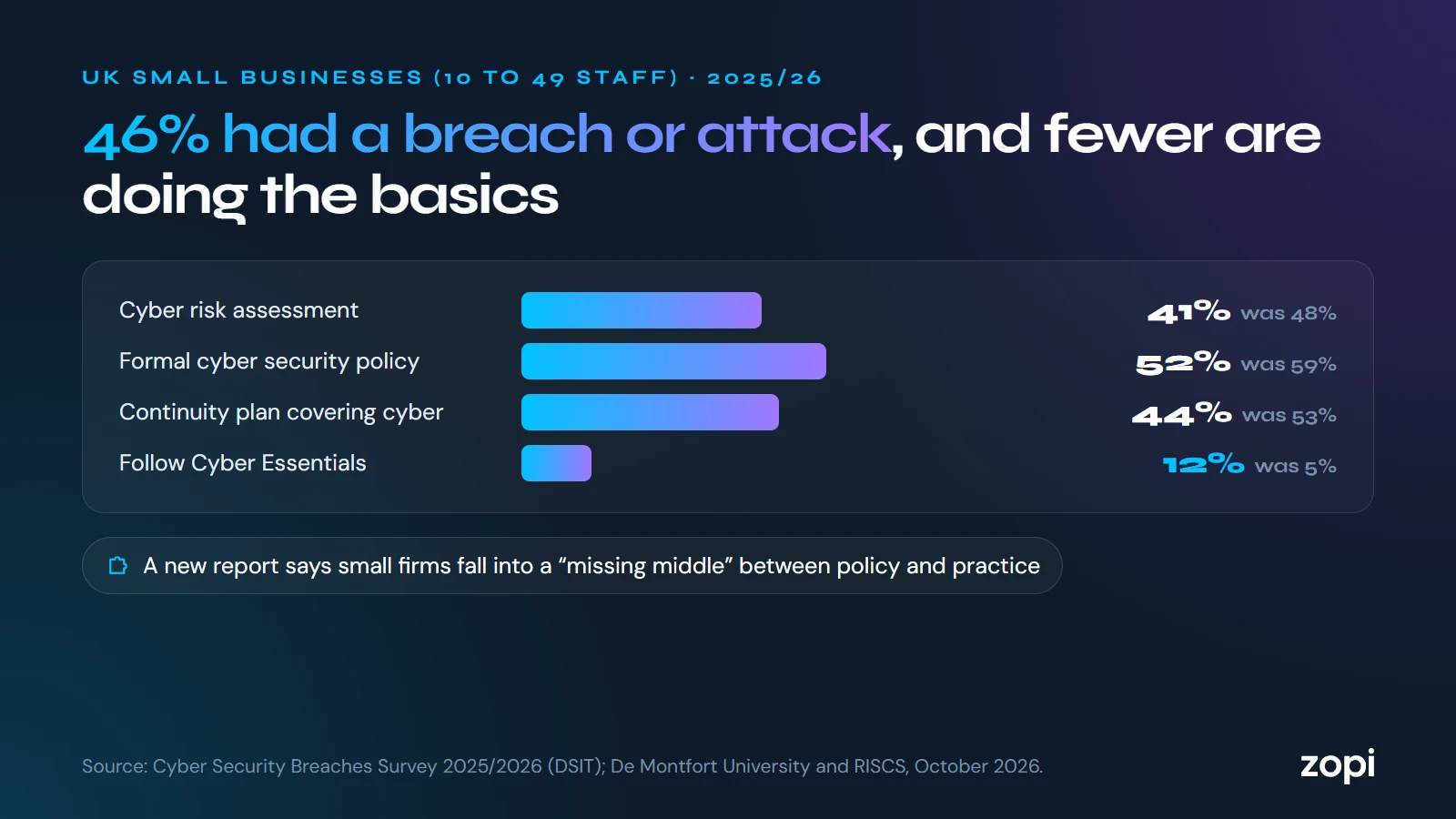
The government's Cyber Security Breaches Survey 2025/2026 found that 46% of small businesses (10 to 49 staff) and 42% of micro businesses (under 10) identified a breach or attack in the past year. Among small businesses, fewer were doing the basics than the year before:
| Item | 2024/25 | 2025/26 |
|---|---|---|
| Cyber risk assessment | 48% | 41% |
| Formal cyber security policy | 59% | 52% |
| Continuity plan covering cyber | 53% | 44% |
| Following Cyber Essentials | 5% | 12% |
Source: Cyber Security Breaches Survey 2025/2026, DSIT
There is some good news. More small businesses now follow Cyber Essentials, the government-backed set of basic protections, up from 5% to 12%. And more micro businesses require two-factor sign-in, up from 35% to 43%.
Five basics worth doing this month
1. Turn on two-factor sign-in for email, Microsoft 365 and anything else that offers it.
2. Keep everything updated, including computers, servers, phones and Office. Some versions have just stopped getting updates.
3. Write down a simple plan for what to do if something goes wrong: who to call, and what to switch off first.
4. Check your backups restore, and keep one copy where ransomware can't reach it.
5. Look at Cyber Essentials. Even if you don't certify, its checklist is a good list of basics.
How Zopi can help
This is the "trusted route to professional help" the report talks about. We look after small businesses' IT and cyber security day to day: updates, two-factor sign-in, backups and staff training, in plain English. Call us on 0204 502 1288 for a free, no-obligation chat.
Sources
- Small businesses risk being left behind by UK's cyber security ambitions, report warns, De Montfort University, 20 October 2026
- New report: Beyond Policy to Place, RISCS, 20 October 2026
- Cyber security breaches survey 2025/2026, Department for Science, Innovation and Technology, GOV.UK, 30 April 2026